
Winter Electrical Problems In Commercial Buildings: What Midwest Contractors Need To Know
Getting the winter call for flickering lights, tripped breakers, and overloaded circuits is never fun, especially when tenants still expect normal operations.
Cold snaps push heating systems hard, and the quick “temporary fix” is often more power strips and portable heaters.
Then moisture shows up. Snow melt, condensation, and salty slush track into basements, boiler rooms, loading docks, and outdoor panels.
Suddenly you are chasing short circuits and corroded connectors.
If you work in Indiana, Illinois, or Kentucky, you already know the pattern.
This guide walks you through the winter failure patterns that show up most in commercial buildings across the Midwest, plus a checklist you can use before the next storm hits.
Key Takeaways
Do the load math before crews plug anything in. A typical 120V, 1,500W portable heater pulls about 12.5 amps, which can push shared circuits into nuisance trips fast.
Keep space heaters off power strips and extension cords. The U.S. Consumer Product Safety Commission (CPSC) estimates portable heaters are involved in an average of 1,600 fires per year and specifically calls out the 3-foot clearance rule.
Watch for the frozen pipe cascade. When pipes freeze and burst, building managers add space heaters to warm the area. Those heaters overload circuits not designed for that draw, and now you have two emergencies instead of one.
Make loose connections a first priority. Cold contracts metal, vibration finishes the job, and that combination turns “minor” heat marks into tripped breakers or an arc event.
Test backup power like you mean it. NFPA 110 programs typically include routine inspections, a monthly run under load, and documentation you can hand to an AHJ without scrambling. The CPSC reports roughly 750 deaths from generator-related carbon monoxide poisoning between 2012 and 2022. Most of those were preventable.
Pick the right outdoor enclosure rating. For exterior gear in the Midwest, many contractors step up from NEMA 3R to NEMA 4 or 4X in splash-down or washdown zones to cut moisture-driven failures. Road salt accelerates corrosion on everything it touches.
Why Winter Causes Overloaded Circuits in Commercial Buildings

Winter creates a perfect overload recipe: longer lighting hours, more plug-in loads, and heating systems running at their highest duty cycle.
That is why you see overloaded circuits turn into tripped breakers, flickering lights, and “random” equipment resets.
It is also a season of hidden electrical stress. Cold makes insulation stiffer, metal contracts, and terminations that felt tight in October can start acting up in January.
If you are working in older buildings in Indianapolis, Louisville, Springfield, or Lexington, the original electrical designs did not anticipate the load demands of modern equipment.
If you want one simple planning rule: treat anything expected to run 3 hours or more as a continuous load, and size and schedule it like it matters.
That mindset helps you avoid constant breaker trips when tenants run heaters all day.
Quick Load Reality Check
Portable heaters and breakroom appliances are the usual winter circuit killers because they add high wattage to circuits that already carry lighting, controls, and office loads.
| Common Branch Circuit | Safer “Continuous” Target | What That Means in Plain Terms |
|---|---|---|
| 120V, 15A | 12A (about 1,440W) | One 1,500W heater can be “too much” once you add anything else on the circuit |
| 120V, 20A | 16A (about 1,920W) | Usually supports one 1,500W heater, but two heaters on one circuit is where trouble starts |
| 208V or 240V, 30A | 24A | Often used for larger heating equipment, but terminations and disconnects still need winter checks |
Where To Look First in the Building
Break rooms and tenant suites are where microwaves, toasters, and portable heaters stack loads fast.
Rooftop units and makeup air have heaters, controls, and defrost cycles that can spike demand during cold weather.
Basements and boiler rooms combine damp conditions with vibration that can loosen connectors and corrode junction boxes.
Loading docks bring outdoor moisture right to the electrical outlets through door heaters, dock lights, and plug-in equipment.
Plan inspections before a cold snap, and you cut power outage time. You also save your team from doing electrical repairs in the worst possible conditions.
Space Heater Safety in Commercial Facilities
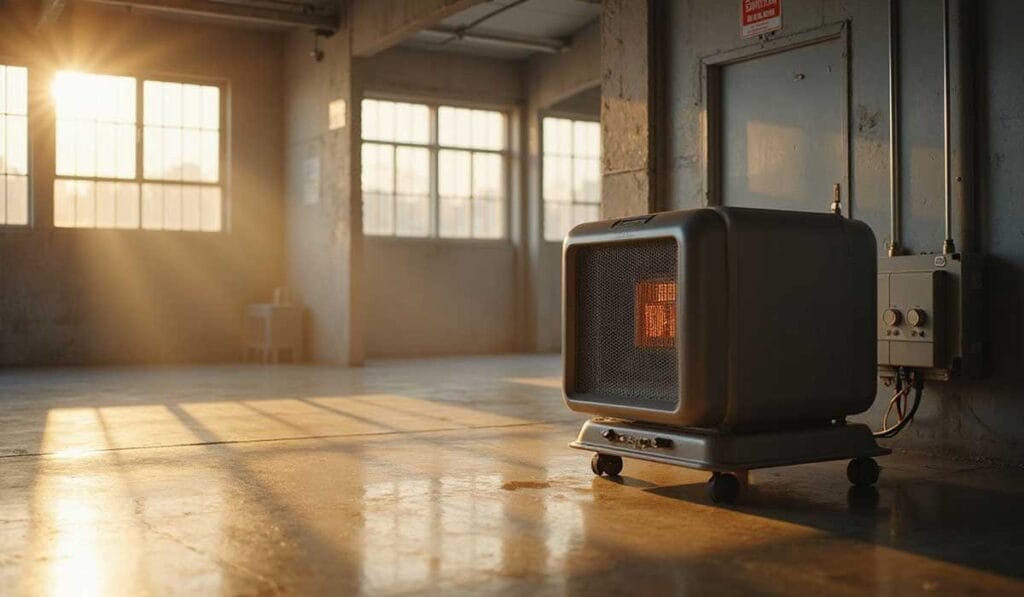
Space heaters show up when a zone is cold, a bay door will not seal, or a tenant complains.
They can also become your fastest path to overloaded circuits, melted plugs, and fire hazards.
The numbers are worth knowing. In a 2025 winter safety reminder, the CPSC estimated portable heaters are involved in an average of 1,600 fires per year (2019 to 2021), resulting in approximately 70 deaths and 150 injuries annually.
The agency specifically calls out the 3-foot clearance rule and warns against connecting heaters to extension cords or power strips.
Set rules before winter weather hits, then enforce them consistently.
Crews follow the standard you make easy.
Non-Negotiables (The Rules That Prevent Most Fires)
Keep 3 feet of clearance from curtains, cardboard, stacked packaging, and furniture.
Plug directly into a wall outlet. No power strips, no extension cords, no daisy chaining.
Use a dedicated circuit when possible, then label it at the breaker panel so the next crew does not guess.
Place on a stable, non-combustible surface, away from traffic lanes and forklift paths.
Require tip-over and overheat shutoff on any portable heaters allowed in the building.
Make the Load Obvious for the Crew
Most portable heaters are 1,500W at 120V, which is about 12.5 amps.
That is close to the “safe” continuous target for a 15A circuit once you add lighting or a battery charger.
Pick the right heater, plug it right, and watch the load.
Before You Add Any Heater Load, Inspect the Weak Spots
Open the nearest junction boxes and look for loose connections, discoloration, and heat damage.
Check for aluminum wiring and verify terminations are rated and torqued correctly for the conductor type.
Replace damaged electrical outlets and any receptacles that feel loose or show arcing marks.
Confirm ground-fault circuit interrupters are installed and working where required, especially in damp or outdoor-adjacent areas.
Use National Electrical Code requirements and your local AHJ interpretations as the baseline, then add your own site rules for portable heater placement and circuit limits.
How Frozen Pipes Cause Electrical Failures
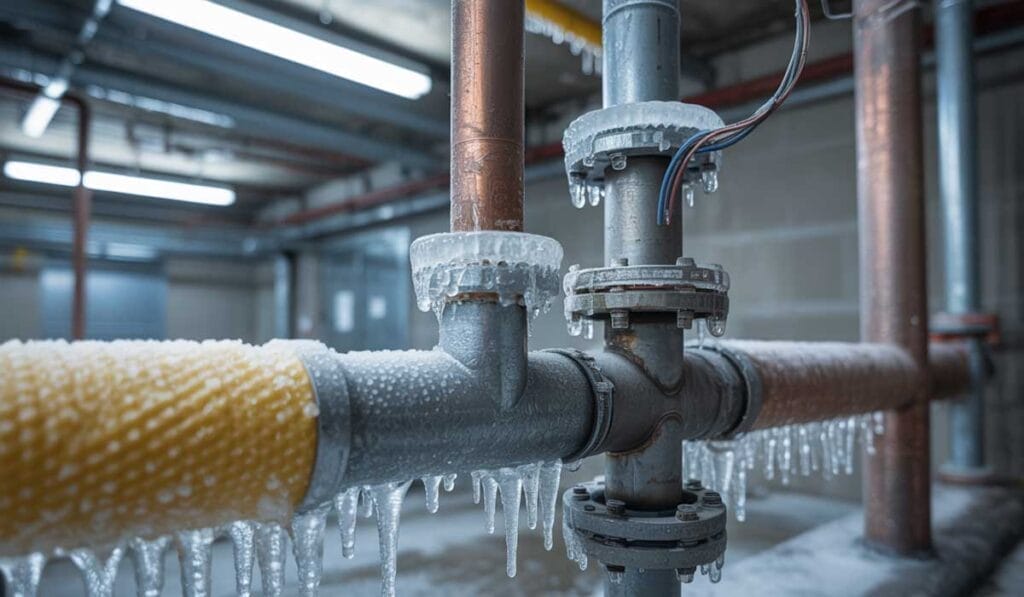
After you get heater risks under control, frozen pipes can create a second wave of common electrical issues.
But here is what most people miss: frozen pipes do not just cause water damage.
They trigger a chain reaction that hits your electrical system from two directions at once.
The Cascade That Catches Buildings Off Guard
When temperatures drop below freezing in an unheated zone, pipes freeze and crack. Building managers respond by rushing space heaters into the affected area.
Those heaters are plugged into the nearest outlet, often on circuits that already carry lighting, controls, or other equipment.
Now you have water spreading through walls toward wiring, and circuits overloading from emergency heating at the same time. Two problems feeding each other.
This cascade is one of the most common winter scenarios contractors in Indiana, Illinois, and Kentucky deal with between December and March.
The fix is not more heaters.
The fix is maintaining consistent building heat so pipes never freeze in the first place, especially in basements, crawl spaces, and mechanical rooms with exposed plumbing.
What Water Exposure Means for Electrical Equipment
A cracked pipe can soak walls, fill a conduit path, or drip straight into a panel area.
Water does three bad things fast: it creates short circuits, it accelerates corrosion, and it turns “normal” troubleshooting into a shock hazard.
CPSC guidance on flood-related hazards is blunt: circuit breakers, GFCIs, and fuses that have been under water should be replaced, even if they seem to work after drying.
Shut down and isolate the affected circuits at the circuit breaker panel before you start opening boxes or pulling devices.
Do not re-energize wet gear to “see what happens.” This goes for GFCI devices, breakers, disconnects, and controls.
Tag and document the wet zone. Record what got wet, how high, and for how long so replacement decisions are quick.
Coordinate plumbing and electrical repairs so you do not seal moisture back into a wall cavity or junction box.
Tools That Speed Up the Root Cause
If you are trying to find where the leak reached the electrical infrastructure, a thermal camera and moisture meter can help you map the wet path without ripping open every wall.
Once you confirm water reached devices, plan replacement and inspection.
That is how you limit power outages and prevent long-term water damage turning into repeat service calls.
Cold Weather Damage to Wiring, Panels, and Breakers
Cold snaps do not “break” electrical systems by themselves. They expose the weak points: aged insulation, tired breakers, marginal terminations, and moisture paths into enclosures.
That is why the same building can run fine all summer, then show flickering lights and tripped breakers the first week temperatures stay below freezing.
How Cold Loosens Connections and Creates Fire Risk
Copper and aluminum wiring contracts when temperatures drop. That contraction pulls connections slightly looser inside panels and junction boxes.
Then when temperatures rise, the metal expands back.
This thermal cycling repeats all winter long, gradually degrading connection integrity with each swing.
Loose connections increase electrical resistance. Increased resistance generates heat at the connection point.
Heat leads to arcing, sparking, and elevated fire risk.
This is why many electrical fires happen during winter months despite the cold environment.
What Happens Inside Circuit Breakers in Extreme Cold
Cold temperatures affect the mechanical operation of breakers in ways you cannot see from the outside.
The lubricants inside the breaker mechanism thicken, and parts can become brittle, potentially slowing the tripping action during an overload or short circuit.
Older panels are especially vulnerable to this.
AFCI breakers add another wrinkle. They are prone to “nuisance tripping” during winter, triggering from arc detection rather than actual overloads.
Even turning high-draw appliances on or off can trip AFCI breakers, and LED bulbs paired with aging lamp sockets contribute additional false triggers.
Wire Insulation Gets Brittle
Cold temperatures cause wire insulation to stiffen and crack over time, especially on older wiring.
Cracked insulation exposes bare conductors and creates paths for arcing, short circuits, and moisture intrusion.
Condensation forms when warm indoor air meets cold surfaces, accumulating in outlets, wiring boxes, and around electrical components.
Static Electricity in Industrial Settings
One winter hazard that gets overlooked in commercial and industrial buildings is static electricity.
Cold, dry winter air generates significant static buildup, particularly in manufacturing and warehouse environments.
That static can damage sensitive electronics, corrupt data, and, in some cases, create a fire risk around flammable materials. Proper grounding and humidity control are the main defenses.
Turn Winter Troubleshooting Into a Repeatable Inspection Plan
The 2023 edition of NFPA 70B moved from a recommended practice to a standard, and workplace safety guidance increasingly expects a documented electrical maintenance program, not just “we fix it when it fails.”
Retorque and reterminate critical panels, contactors, and distribution boards using the manufacturer’s torque values, not “good and tight.”
Use infrared thermography on loaded gear to find hot spots caused by loose connections before they become outages.
Inspect flexible cords and temporary feeds for wear, jacket cracks, and pinch points that show up in cold weather.
Verify surge protection at the service and critical distribution, and replace any surge protectors that show fault indications.
Signs You Should Plan Electrical Panel Replacement
Breakers trip repeatedly with normal loads and no clear fault.
Visible corrosion, water staining, or dirt tracks inside the breaker panel.
Heat damage at bus stabs, breaker clips, or neutral and ground bars.
Obsolete equipment or unsafe legacy wiring methods, including any knob-and-tube wiring discovered during renovations.
When you combine cold contraction with moisture intrusion, small defects cascade.
Preventative maintenance keeps reliability up and keeps your winter electrical repairs from turning into emergency shutdowns.
GFCI and AFCI Tripping in Winter
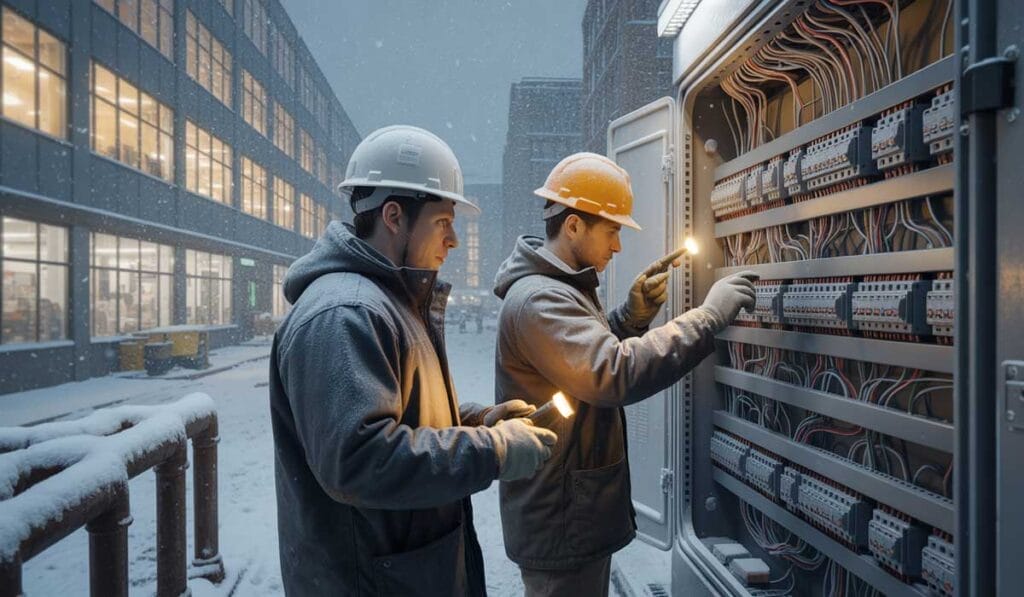
GFCI and AFCI devices are supposed to trip. In winter, they trip more because moisture shows up in places you do not see in July, and cold weather makes marginal connections noisier electrically.
Start by treating every trip as data. If you reset and walk away, you miss the pattern that points you to the real root cause.
Where Commercial Buildings Most Often Need GFCI Attention
NEC rules for other-than-dwelling occupancies commonly require GFCI protection in places like rooftops, outdoors, unfinished basements, garages, damp or wet locations, and near sinks.
Winter puts many of those areas in “wet location behavior,” even if they are indoors.
Rooftop receptacles for HVAC service gear are exposed to snow, ice, and wind-driven moisture.
Outdoor and loading dock receptacles take direct hits from slush and spray.
Basement outlets collect condensation that forms on cold piping.
Break rooms and kitchenettes near sinks and beverage stations see constant water exposure.
A Fast Troubleshooting Flow for Nuisance Trips
Identify what changed. Were portable heaters added, cords rerouted, door heaters installed, or new cleaning routines started?
Inspect for moisture. Open weatherproof covers, check gasket integrity, and look for water tracks into junction boxes.
Check terminations. Cold contraction can loosen device screws, neutrals, and shared neutral connections.
Test the device. Use the built-in test, then confirm with appropriate test equipment if you are qualified.
Fix the cause. Replace frayed wires, rebuild wet boxes, and remove power strips used as permanent feeds.
If trips continue or you hear buzzing or arcing sounds, bring in a licensed electrician. Winter is the wrong time for guesswork around live parts.
Generator Safety and Backup Power
If your utility power goes out during a Midwest winter storm, your backup plan cannot be “we will figure it out in the dark.”
Generator safety and readiness is a winter requirement in commercial buildings across Indiana, Illinois, and Kentucky.
Carbon Monoxide: The Invisible Killer During Winter Outages
This is the stat that should change how you think about generator placement.
The CPSC reports that from 2012 to 2022, approximately 750 deaths were associated with carbon monoxide poisoning from portable generators alone.
A gasoline-powered generator can produce as much CO as hundreds of cars running at the same time.
Generators must be positioned outdoors, at least 20 feet from doors, windows, and vents, with 3 to 4 feet of clearance on all sides for proper ventilation.
Running generators indoors, in basements, or in garages (even with doors open) creates lethal CO concentrations within minutes.
Backfeeding: The Mistake That Electrocutes Utility Workers
When a generator connects directly to building wiring without a proper transfer switch, electricity flows backward into the utility lines.
Line workers restoring power after a storm do not expect live current on what should be a dead line. This is called backfeeding, and it kills people.
Every commercial generator installation needs a properly rated automatic transfer switch (ATS) or manual transfer switch that isolates the generator from the grid. No exceptions.
NFPA 110 Maintenance Schedule
NFPA 110 programs commonly call for routine inspections and a monthly exercise under load for at least 30 minutes, plus logs that document what happened and what you fixed.
| Task | Suggested Winter Cadence | What You Are Preventing |
|---|---|---|
| Visual inspection (leaks, coolant heater, battery, alarms) | Weekly during peak winter | No-start events and fuel or coolant surprises |
| Exercise under load (with ATS verification) | Monthly | Failures that only show up under real load transfer |
| Documentation and fault review | Every run | Repeat failures and “no record” problems during inspections |
| Supplemental load bank testing (as needed) | Per the edition adopted by your AHJ | Wet stacking, poor performance, and unknown capacity |
Seven Checks That Prevent Winter Power Outages From Getting Worse
Run the set under a meaningful load, then confirm voltage and frequency stay stable.
Verify the automatic transfer switch actually transfers and returns, and that it does not hang up.
Confirm your critical circuit list (lighting, hot water, garage doors, and controls) matches what the ATS feeds.
Inspect battery age and connections, and clean and tighten terminals as needed.
Check fuel quality and filters, especially if the tank sits through seasonal swings.
Walk the exhaust and ventilation path so snow and drifting do not block airflow.
Train your team on safe shutdown and fuel handling so a storm response does not become an injury event.
When you tie generator readiness to your GFCI and AFCI trip history, you protect reliability on both sides of the outage.
Protecting Outdoor Electrical Equipment
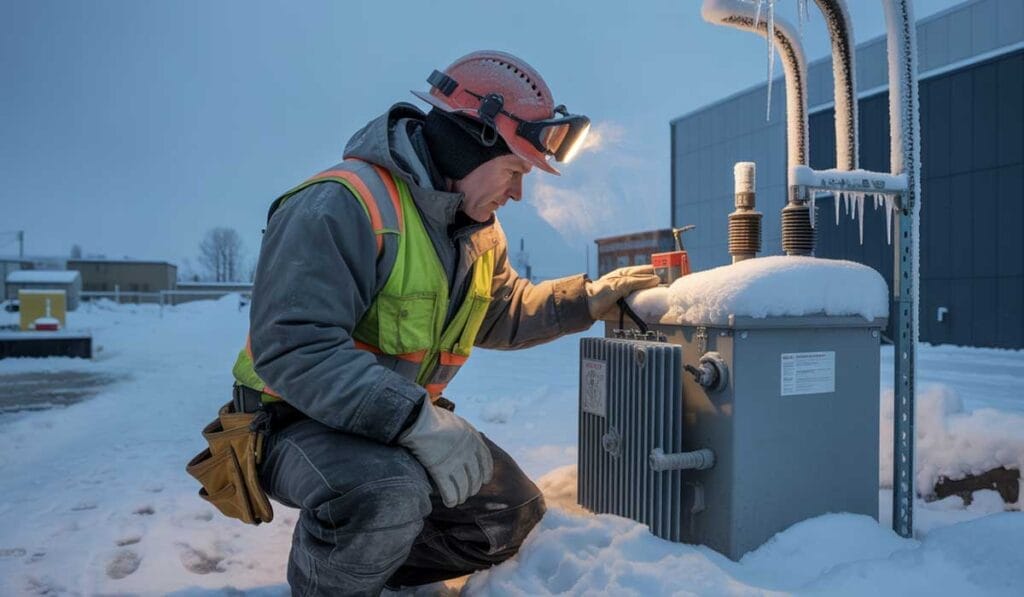
Outdoor equipment failures spike in Midwest winters because you get moisture, freeze-thaw cycles, and physical abuse from plows, salt, and drifting snow.
Your goal is simple: keep water out and keep enclosures stable.
Road Salt and Corrosion: A Midwest-Specific Problem
If you work anywhere in Indiana, Illinois, or Kentucky, you already know what road salt does to vehicles, concrete, and metal railings.
It does the same thing to outdoor electrical equipment. Salt-laden spray from parking lots, loading docks, and roadways accelerates corrosion on metal enclosures, conduit, and connection hardware.
This is not a gradual problem. In a heavy salt season, you can see visible corrosion develop in weeks on unprotected equipment.
PVC conduit has its own cold weather issue. It becomes brittle in sustained cold and is vulnerable to cracking, especially at joints and bends.
Ice accumulation on lighting fixtures and signage adds weight that stresses mounting hardware and electrical connections, creating both mechanical and electrical failure paths.
Match the Enclosure Type to the Actual Exposure
Many contractors use NEMA ratings as a quick decision tool.
| Scenario | What To Spec or Verify | Why It Matters in Winter |
|---|---|---|
| Standard exterior wall panels | NEMA 3R minimum | Better protection from precipitation and drifting snow |
| Areas hit by spray, hose-down, or heavy wind-driven moisture | NEMA 4 | Reduces water intrusion that leads to short circuits |
| Corrosive exposure (salt, chemicals, food processing exteriors) | NEMA 4X materials and hardware | Helps slow corrosion at connectors and bonding points |
Outdoor Winterization Steps That Pay Back Fast
Seal conduit entries and replace cracked hub seals or gaskets.
Mount enclosures above expected snow and splash height, and keep weep paths clear.
Use in-use covers on exterior receptacles, then verify they still close with cords plugged in.
Build drip loops and strain relief into cord paths so water does not track into boxes.
Protect vulnerable conduits from impact, and add guards where plows and pallets get close.
Fix corrosion early, then recheck bonding and grounding continuity.
Follow OSHA energy control practices during outdoor maintenance, including lockout and tagout, so wet conditions do not turn into an electrocution event.
Winter Electrical Prevention Checklist
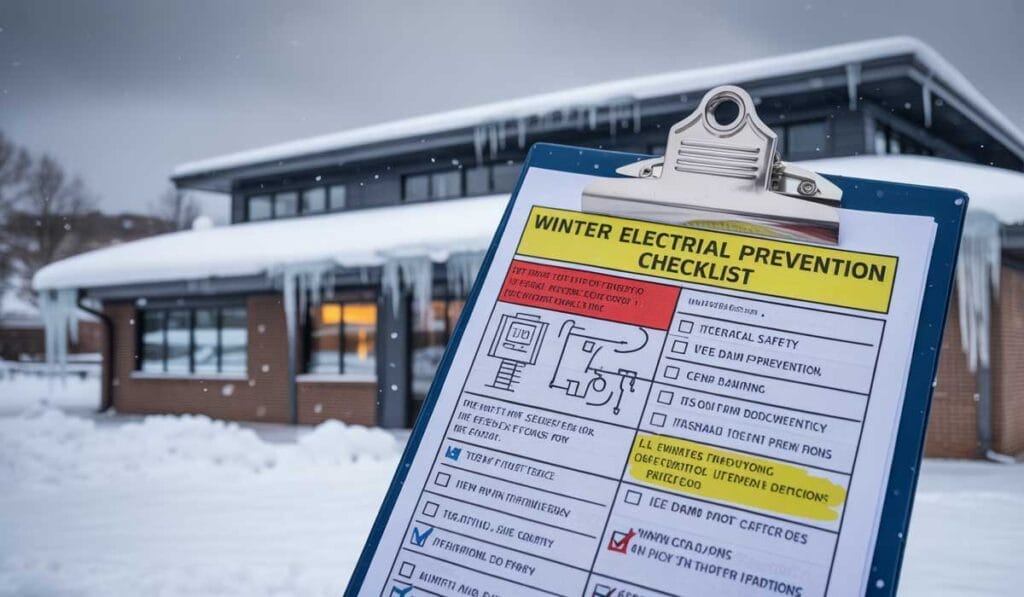
Winter hits hard across Indiana, Illinois, and Kentucky, and commercial buildings feel it at the panel, on the roof, and at every exterior door.
Use this checklist to reduce overloaded circuits, cut power outages, and tighten up electrical safety before the next cold snap.
Pre-Freeze Walkthrough (1 to 2 Weeks Before Peak Cold)
Inspect HVAC systems, boilers, and controls. Tighten terminations and correct any heat marks before they become tripped breakers.
Monitor and label circuit loads. Identify which breaker panel spaces feed break rooms, tenant suites, and dock equipment.
Set a portable heater policy. Dedicated outlets only, no extension cords. Remove power strips used for permanent heating.
Test the generator and ATS. Run under load and log runtime, alarms, and transfer behavior.
Review your building load profile. Compare winter demand estimates against panel capacity and flag circuits that need upgrades before peak cold hits.
Moisture and Outdoor Equipment Checks
Seal outdoor junction boxes and verify gasket condition, especially on rooftop disconnects and exterior receptacles.
Inspect for brittleness and frayed wires at door heaters, RTU whips, dock gear, and temporary winter setups.
Check GFCI and AFCI devices. Test and log results, then investigate repeat trips instead of resetting and moving on.
Verify surge protection status lights or indicators at service and critical distribution points, and replace failed units.
Look for water paths. Melting ice often finds the same gaps each year, so fix the path, not just the symptom.
Inspect outdoor equipment for salt corrosion, especially at loading docks, parking lot light poles, and any enclosures within splash range of treated roadways.
Document what you find. Good records make electrical maintenance faster, protect you during audits, and improve reliability over the full winter season.
Frequently Asked Questions
Cost and Value Questions
How much does a pre-winter electrical inspection cost for a commercial building? A basic pre-winter electrical inspection for a commercial building typically runs between $300 and $1,500, depending on building size, panel count, and the scope of testing required. Buildings with multiple panels, rooftop equipment, and outdoor fixtures land on the higher end. The cost is small compared to an emergency service call during a winter storm, which can easily run 2 to 3 times the normal rate. Contact New Century Sales at (317) 334-9697 for recommendations on qualified contractors in Indiana, Illinois, or Kentucky.
What factors affect the cost of winter electrical repairs? The biggest cost drivers are the age of the building’s electrical system, the number of panels and circuits involved, whether asbestos or other hazardous materials are present, and how much water damage has occurred. Emergency repairs during a storm or outage cost significantly more than planned maintenance. Buildings constructed before 1990 often need more extensive work because the original wiring was not designed for modern load demands.
Is preventative winter electrical maintenance worth the investment? Yes. A documented maintenance program costs a fraction of what you pay for emergency repairs, lost production time, and equipment replacement after a winter failure. One tripped breaker in a server room or cold storage facility can cause thousands of dollars in damage within hours. NFPA 70B now requires documented electrical maintenance programs, so the investment also keeps you compliant.
How long does a commercial electrical inspection take? A thorough pre-winter inspection takes 2 to 6 hours for a typical commercial building, depending on square footage, the number of electrical panels, and how much outdoor equipment needs to be checked. Larger industrial facilities with multiple buildings or rooftop units may take a full day. Schedule inspections at least 2 weeks before your area’s first expected hard freeze.
When should I schedule pre-winter electrical maintenance? Schedule pre-winter maintenance in early to mid-fall, ideally by late October in Indiana, Illinois, and Kentucky. This gives you time to address any issues found during inspection before sustained cold weather arrives. Waiting until December means you are competing with every other building that put it off, and contractors are busier and more expensive during peak winter.
What is the step-by-step process for winterizing a commercial electrical system? Start with a full panel inspection including retorquing connections. Then test all GFCI and AFCI devices and log results. Next, inspect outdoor enclosures and seal any gaps. Review your building’s load profile against winter demand estimates. Test the generator under load and verify the transfer switch. Set and communicate your space heater policy. Finally, document everything and create a schedule for mid-winter follow-up checks.
What is the difference between GFCI and AFCI protection? GFCI (Ground Fault Circuit Interrupter) protection detects current leaking to ground, typically through moisture or a person, and shuts off power to prevent electrocution. AFCI (Arc Fault Circuit Interrupter) protection detects dangerous arcing caused by damaged wiring or loose connections and shuts off power to prevent fires. In winter, GFCIs trip more often due to moisture intrusion, while AFCIs can nuisance-trip from LED bulbs, aging lamp sockets, or high-draw equipment cycling on and off.
NEMA 3R vs NEMA 4 enclosures: which do I need for outdoor electrical equipment? NEMA 3R provides basic protection from rain, sleet, and ice formation and works for standard exterior wall-mounted panels. NEMA 4 adds protection against windblown dust and rain, splashing water, and hose-directed water, making it the better choice for areas hit by spray, hose-down, or heavy wind-driven moisture. In Midwest locations with heavy road salt exposure, consider NEMA 4X for added corrosion resistance.
Should I repair or replace an aging electrical panel? If your panel trips repeatedly under normal loads, shows visible corrosion or water staining, has heat damage at bus stabs or breaker clips, or uses obsolete equipment, replacement is usually the smarter investment. Patching an undersized or deteriorated panel is a temporary fix that costs more in repeat service calls than a one-time replacement. A qualified electrician can assess whether your specific panel is worth upgrading.
How do I know if my building’s electrical system can handle winter loads? Compare your building’s total connected winter load (HVAC, lighting, heating equipment, plug loads) against the panel’s rated capacity. If you are regularly tripping breakers when tenants add space heaters, your system is already at or past its limit. A load profile review by a qualified electrician will tell you exactly where you stand and which circuits need upgrades.
What happens if I skip pre-winter electrical maintenance? Skipping maintenance means small problems become big ones under winter stress. Loose connections that were fine in September become arc hazards when cold contraction pulls them tighter. Moisture finds every gap in outdoor enclosures. Generators that were not tested sit idle until they fail during the storm you actually need them for. The result is emergency repairs at premium rates, extended downtime, and potential safety hazards for your building occupants.
Why do my lights flicker when it gets cold outside? Flickering lights in cold weather typically point to one of three issues. Circuit overload from high winter electrical usage causes voltage drops when heavy loads cycle on and off. Loose connections from wire contraction create intermittent contact that shows up as visible flickering. Grid-level voltage fluctuations during cold snaps affect entire neighborhoods when electrical demand peaks across all properties at the same time. Start troubleshooting at the nearest upstream device and work back toward the panel.
Can I do a basic winter electrical check myself, or do I need a licensed electrician? You can do a visual walkthrough yourself: look for tripped breakers, test GFCI outlets using the built-in test button, check for scorch marks or burning smells at panels, and inspect outdoor enclosures for damage. But anything involving opening panels, retorquing connections, testing under load, or working on live equipment requires a licensed electrician. Winter conditions make electrical work more dangerous, and wet environments increase shock risk significantly.
What tools do I need for winter electrical troubleshooting? For basic troubleshooting, you need a quality multimeter, a non-contact voltage tester, and a GFCI tester. For more thorough inspections, add a thermal imaging camera (to find hot spots at connections without opening panels under load) and a moisture meter (to trace water paths from frozen pipe breaks). Clamp-on ammeters help you verify actual circuit loads against rated capacity so you can identify overloaded circuits before they trip.
What are the most common mistakes contractors make with winter electrical work? The top mistakes are resetting tripped breakers without investigating the cause, allowing space heaters on power strips or extension cords, skipping generator testing until an outage happens, ignoring moisture intrusion in outdoor enclosures until corrosion causes a failure, and torquing connections by feel instead of using manufacturer-specified values. Every one of these shortcuts turns into a bigger problem when winter conditions push systems to their limits.
Is my building at higher risk if it was built before 1990? Yes. Buildings constructed before 1990 typically have electrical systems designed for much lower load demands than what modern tenants and equipment require. Original panel capacity, wire sizing, and circuit counts often fall short of current needs, especially during winter when heating loads spike. If your building has not had a major electrical upgrade, a load profile review should be a priority before winter.
What should I do if I smell burning near an electrical panel in winter? Shut off the main breaker immediately if you can do so safely, evacuate the area, and call a licensed electrician. A burning smell near a panel usually means a connection is overheating, arcing, or already on fire inside the enclosure. Do not open the panel yourself. Do not try to identify the source with the panel energized. This is an emergency that requires a professional response.
What if my generator fails to start during a winter power outage? Cold weather is the number one cause of generator no-start events. Low battery charge, thickened oil, fuel quality problems, and frozen coolant lines all prevent generators from starting when you need them most. If the generator will not start, do not attempt repeated cranking, as this can drain the battery completely. Call your generator service provider. For future prevention, install a block heater, test monthly under load, and keep batteries on a maintenance charger through the winter months. NCS can connect you with generator equipment suppliers across Indiana, Illinois, and Kentucky at (317) 334-9697.
What should I do if water from a burst pipe reaches my electrical panel? Do not touch the panel or attempt to dry it while it is energized. Shut off power at the upstream disconnect or utility service if you can reach it safely. Then call a licensed electrician immediately. CPSC guidance states that circuit breakers, GFCIs, and fuses that have been submerged or exposed to significant water should be replaced, not just dried out and re-energized.
Keep Your Facilities Running This Winter
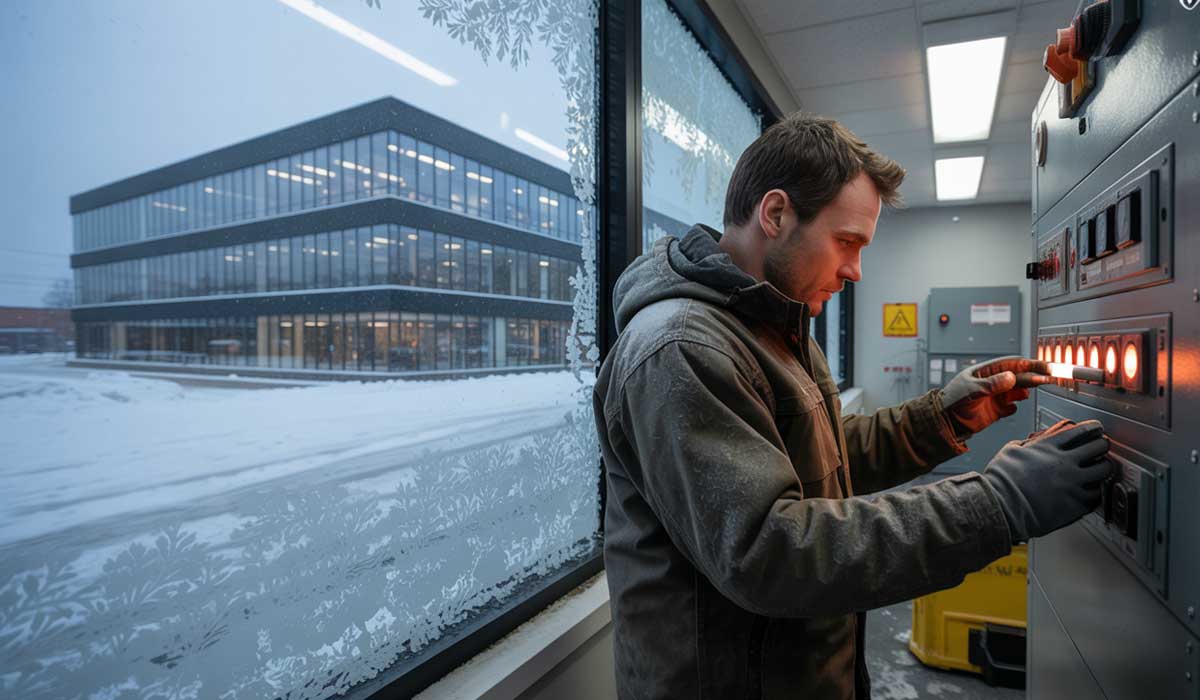
Winter electrical problems in Midwest commercial buildings are predictable. That means they are preventable if you plan ahead instead of reacting after the first failure.
New Century Sales, Inc. has served electrical contractors and distributors across Indiana, central and southern Illinois, and Kentucky since 1999. With over 200 combined years of experience in the electrical industry, NCS connects you with the manufacturers and products you need to keep commercial buildings running safely through the toughest winter conditions.
Whether you need recommendations on panels, breakers, surge protection, generator components, enclosures, or lighting for your next winter project, the NCS team can help.